
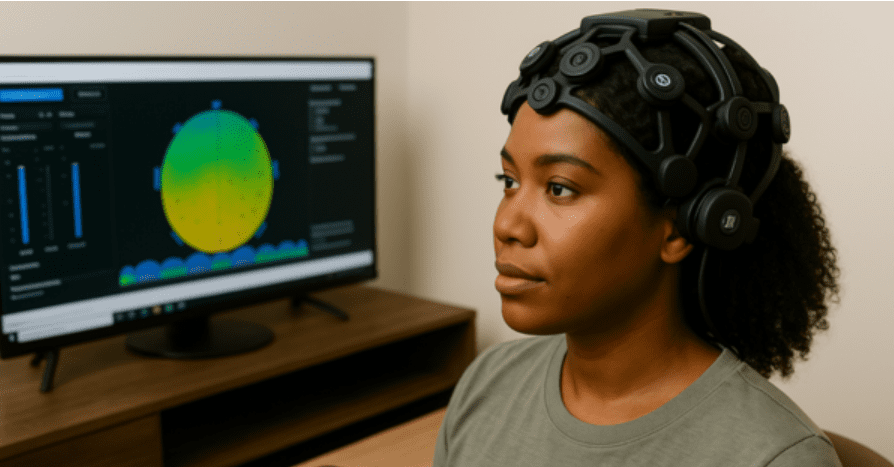

Depression affects millions of people worldwide—but what if your brain could show us exactly where the problem lies?
At Neuron Connect, we use a breakthrough tool called qEEG (quantitative electroencephalography) to uncover how your brain is functioning in real-time. This advanced brain mapping technology is helping people get faster, more personalized, and more effective treatment for depression—without guesswork.
Here’s how qEEG is transforming how we understand and treat depression.
What Is qEEG (Quantitative EEG)?
qEEG is an upgraded version of a standard EEG (electroencephalogram). While a basic EEG shows raw brainwave activity, qEEG uses computerized analysis to identify patterns and imbalances linked to mental health issues—including depression.
Think of it as a brain map that shows where your brain is underactive, overactive, or out of sync—so your provider can design a treatment plan that actually fits you.
Depression & the Brain: What’s Really Going On?
Depression isn’t just emotional—it’s neurological. Research shows that depression is often tied to irregular brainwave activity in areas like:
- Prefrontal cortex (decision-making & mood regulation)
- Amygdala (emotions)
- Hippocampus (memory)
- Anterior cingulate cortex (emotional balance)
For example:
- Too much theta activity in the front of the brain can lead to brain fog and low motivation
- Too little alpha or beta activity can affect mood and focus
With qEEG, we can see these imbalances—and then treat them directly.
How qEEG Improves Depression Diagnosis
Traditionally, depression is diagnosed through questionnaires and self-reports. But these methods are subjective and can vary between providers.
qEEG adds objective data by:
- Identifying unique brainwave “biomarkers” linked to depression
- Distinguishing depression from similar conditions like anxiety or ADHD
- Pinpointing exactly where the brain is underperforming
It’s personalized, precise, and rooted in neuroscience.
Personalized Depression Treatment With qEEG
Once your brain map is complete, your provider at Neuron Connect creates a custom treatment plan based on your brain’s needs—not a one-size-fits-all protocol.
Here’s how we use qEEG to boost treatment outcomes:
1. Neurofeedback Therapy
Neurofeedback therapy is brain training based on your qEEG results. It helps your brain learn to:
- Increase alpha and beta waves (improve focus, mood, energy)
- Decrease theta waves (reduce fogginess and inattention)
People often report better sleep, clearer thinking, and improved emotional balance.
2. Smarter Medication Decisions
Instead of trial-and-error prescribing, qEEG helps guide medication choices by tracking how your brain responds to antidepressants.
- Find the right medication faster
- Monitor effectiveness without guesswork
- Adjust dosages with real-time brain feedback
3. Targeted TMS Therapy
Transcranial Magnetic Stimulation (TMS) uses magnetic pulses to stimulate specific brain regions. qEEG helps locate exactly where to apply TMS for the best results.
This makes TMS more accurate, effective, and tailored to your brain.
Challenges to Consider
While qEEG is powerful, it’s still growing as a clinical tool. Some key challenges include:
- Standardization: Not all clinics use the same methods—Neuron Connect follows clinically validated protocols.
- Access & cost: qEEG equipment can be expensive, but Neuron Connect offers flexible payment options.
- Privacy: Brainwave data is sensitive, and protecting it is a top priority.
At Neuron Connect, we’re committed to ethical, secure, and affordable care using the latest neuroscience.
What the Future Holds for qEEG & Depression
The research into qEEG is expanding fast. Some exciting developments include:
- AI & machine learning to detect patterns and predict treatment success
- Long-term tracking of patients to study how brainwave changes last over time
- Combining qEEG with fMRI and PET scans for a 360° view of brain health
As technology improves, so does our ability to deliver precise, drug-free, and long-lasting solutions for depression.
Final Thoughts
qEEG is a game-changer for anyone struggling with depression. At Neuron Connect, we use this cutting-edge brain mapping to:
- Get a clearer picture of your mental health
- Build a custom treatment plan that fits you
- Guide neurofeedback, medication, and TMS with confidence
- Track your progress in real time
Want to know what your brain is saying about your mood?
Schedule Your Brain Map Today
If you or a loved one is dealing with depression, don’t settle for guesswork.
➡️ Book a qEEG brain mapping session with Neuron Connect today and take the first step toward real, lasting relief.
References:
Davidson, R. J. (2002). “Anxiety and affective style: Role of prefrontal cortex.” Biological Psychiatry.
Hammond, D.C. (2011). “What is Neurofeedback: An Update.” Journal of Neurotherapy.
Arns, M. et al. (2015). “EEG biomarkers in depression.” Clinical EEG and Neuroscience.
American Psychiatric Association. (2023). Depression Treatment Guidelines.